No products in the cart.

On a tree-lined boulevard in Hanoi at dusk, a young woman glides past on a bicycle. Her áo dài catches the late sun, and for a fleeting second the panels lift behind her like butterfly wings. Silk ripples. Light moves through fabric. The city hums around her, but she seems suspended in her own quiet current of grace.
That flutter—that almost-weightless motion—is often a traveler’s first memory of Vietnam’s most iconic garment.
The áo dài is more than national attire. It is a visual shorthand for Vietnam itself.
Worn by schoolgirls in crisp white, by flight attendants greeting international arrivals, by brides in shimmering brocade, the garment carries an unmistakable symbolism: refinement, continuity, and cultural pride. In a country shaped by dynasties, colonial encounters, war, and rapid modernization, the áo dài has endured as a steady thread.
It also embodies something less visible but deeply felt—the quiet resilience of Vietnamese women. The silhouette is delicate, even ethereal. Yet the history behind it tells a story of endurance and adaptability. Through shifting eras and social expectations, women have worn the áo dài not as costume, but as lived identity.
Grace, yes—but never fragility.
Part of the áo dài’s magnetism lies in its paradox.
At first glance, it is modest: a high collar framing the neck, long sleeves skimming the arms, fabric flowing nearly to the ankles. Nothing about it screams spectacle.
And yet.
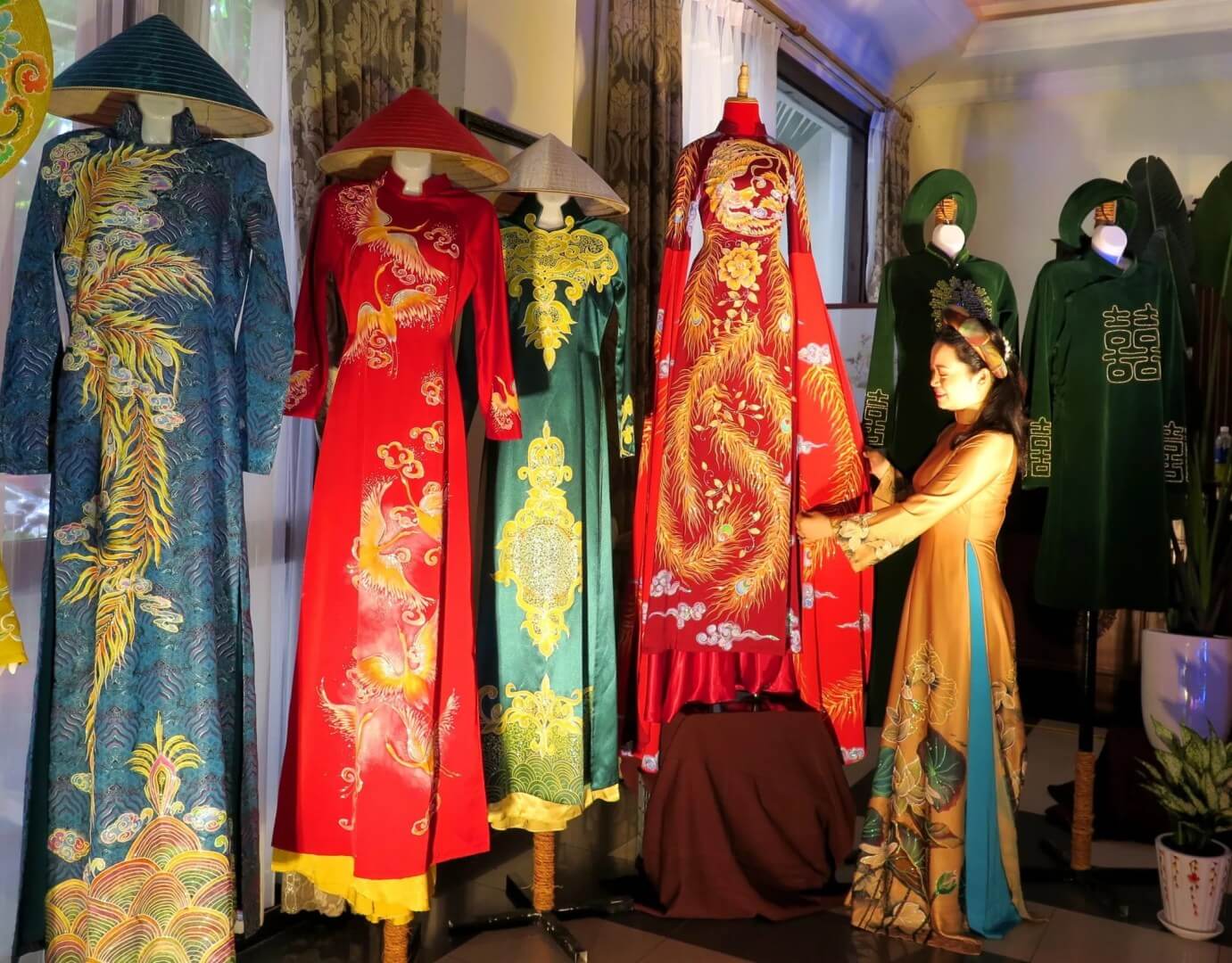
Look closer and you see its subtle daring. The gown is cut close to the body, tracing natural lines without exaggeration. High slits at the sides—often rising to the waist—allow movement and reveal the wide silk trousers beneath. As the wearer walks, the panels separate and reunite, creating rhythm and allure without overt exposure.
It’s a masterclass in balance: restraint paired with sensuality, structure softened by motion. In Western fashion terms, it accomplishes what designers often chase but rarely perfect—the coexistence of elegance and ease.
The roots of the áo dài stretch back centuries, shaped by royal decrees during the Nguyen dynasty. Early versions were influenced by Chinese court dress, signaling refinement and hierarchy. Over time, particularly in the 20th century, Vietnamese designers reimagined the form—narrowing the fit, refining the tailoring, introducing lighter fabrics.
French colonial presence left subtle imprints on construction techniques, and by the 1930s the áo dài had evolved into a distinctly modern silhouette.
Today it lives many lives. It appears in contemporary fashion collections in Ho Chi Minh City. It walks international runways. It’s tailored in jewel-toned velvet for weddings and rendered in minimalist linen for creative professionals. Designers experiment with sheer overlays, digital prints, even architectural seams—yet the essence remains unmistakable.
The high collar.
The long panels.
The poetry of movement.
To see an áo dài in motion is to understand that it cannot be reduced to “traditional dress.” It is not frozen in a museum case. It breathes with the women who wear it—to work, to school, to ceremonies, to celebrations.
For travelers, the temptation is to photograph it as a charming cultural detail. But linger a moment longer. Watch how the silk catches the wind along the Perfume River in Hue, or how it glows against the lantern light of Hoi An at night.
What you’re witnessing isn’t just fashion.
It’s history stitched into fabric. It’s identity shaped by centuries. It’s a reminder that clothing, at its most powerful, becomes language.
And the áo dài speaks—softly, gracefully, and with enduring strength.
Information
Follow Us
Payment channels