No products in the cart.

The road narrows, the traffic thins, and suddenly you’re standing in a courtyard where skeins of jewel-toned silk sway in the breeze like prayer flags.
This is the side of Vietnam most travelers miss.
Beyond the buzz of Hanoi and the lantern glow of Hoi An, traditional handicraft villages are still very much alive—places where families have passed down techniques for generations, where clay-streaked hands and lacquer-stained fingernails tell stories no souvenir shop ever could.
If you want to understand Vietnam through touch, texture, and time, this is where you start.
In villages known for silk weaving, the air hums with the steady rhythm of wooden looms.
Threads stretch tight across frames. Shuttles fly back and forth in a blur. What begins as delicate strands from silkworm cocoons transforms into fabric that feels impossibly light against your skin.
You’ll see:
Vietnamese silk isn’t just fabric—it’s fluid, luminous, almost liquid in motion. Run your fingers across it and you’ll understand why it has been prized for centuries.
If you’re shopping, look for pieces made on-site. The subtle irregularities are part of the charm. Perfectly imperfect means it’s the real deal.
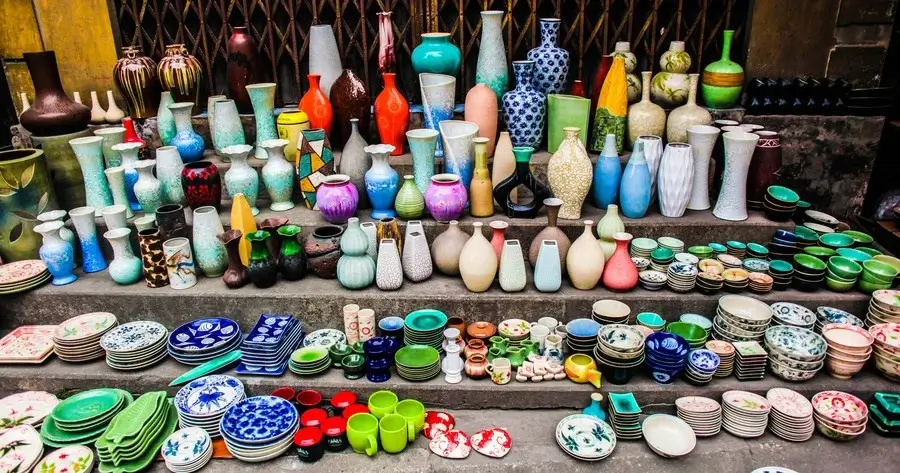
A short drive from Hanoi, ceramic villages feel like open-air studios.
Kilns glow behind brick walls. Shelves overflow with vases, tea sets, and hand-painted bowls in shades of milky white and cobalt blue. The scent of wet clay hangs in the air.
Watch a potter at work and it’s almost meditative. The wheel spins. Hands steady. A lump of earth rises and curves into something graceful.
What makes Vietnamese ceramics special is the blend of practicality and artistry. Everyday objects—rice bowls, teapots, serving platters—are elevated with delicate brushwork and subtle glazes.
These aren’t mass-produced trinkets. They’re functional art meant to be used, chipped, loved.
Lacquerware is where patience becomes visible.
Artisans layer resin from lacquer trees over wood or bamboo, sanding and polishing between each coat. The process can take weeks—sometimes months. Gold leaf, crushed eggshell, and mother-of-pearl are embedded into the surface, creating shimmering scenes of village life or abstract patterns that catch the light.
Stand close and you’ll notice the depth. The surface isn’t flat; it’s dimensional, almost glowing from within.
It’s meticulous work. One wrong move can mean starting over. That dedication shows up in the finished piece—a jewelry box that feels heirloom-worthy, a tray that doubles as wall art.
Lacquerware is Vietnam’s slow art in a fast world.
Handicraft villages aren’t staged experiences. Kids ride bikes past workshops. Grandparents shell peanuts in the shade. Production happens alongside daily life.
If you visit, go with curiosity. Ask questions. Watch the process. Buy thoughtfully.
Because when you pack a silk scarf or ceramic bowl into your suitcase, you’re not just bringing home a souvenir.
You’re carrying a fragment of living tradition—shaped by hands, fire, thread, and time.
Information
Follow Us
Payment channels